The Art of Refinement: What Refinishing Wheels Taught Me About Improving Almost Anything
I love classic cars.
Like most hobbies, they can become as expensive as you’re willing to let them. One of the ways I’ve made a small collection financially practical is by buying cars that need improvement instead of buying finished examples. That means I’ve had to learn to do much of the work myself. Over the years, that decision has led me to learn skills I never expected to have: paint work, electrical diagnosis, suspension rebuilds, upholstery repair, and countless hours chasing problems that only seem simple after you’ve solved them.
One of those skills is refinishing aluminum wheels.
I learned it for practical reasons. I wanted wheels that looked better than I could justify buying. After refinishing enough sets, I started to notice that I was asking myself the same questions every time I picked up a wheel. Eventually it dawned on me that I wasn’t just learning how to restore aluminum. I was learning something about the process of refinement itself.
Start with the foundation
The process always begins with a question:
What’s the deepest imperfection?
Before you can answer that question, though, you have to answer another one.
Is the wheel actually worth refinishing?
If it’s cracked, don’t polish it. If it’s bent, straighten it first. If it’s structurally compromised beyond repair, replacing it may be the only responsible option. Refinement assumes the underlying substrate is sound. Before you improve something, you have to know whether you’re refining it, repairing it, or replacing it. Those are different kinds of work, and confusing them usually leads to wasted effort.
Begin with the deepest imperfection
Assuming the wheel is worth saving, the deepest imperfection determines where you begin.
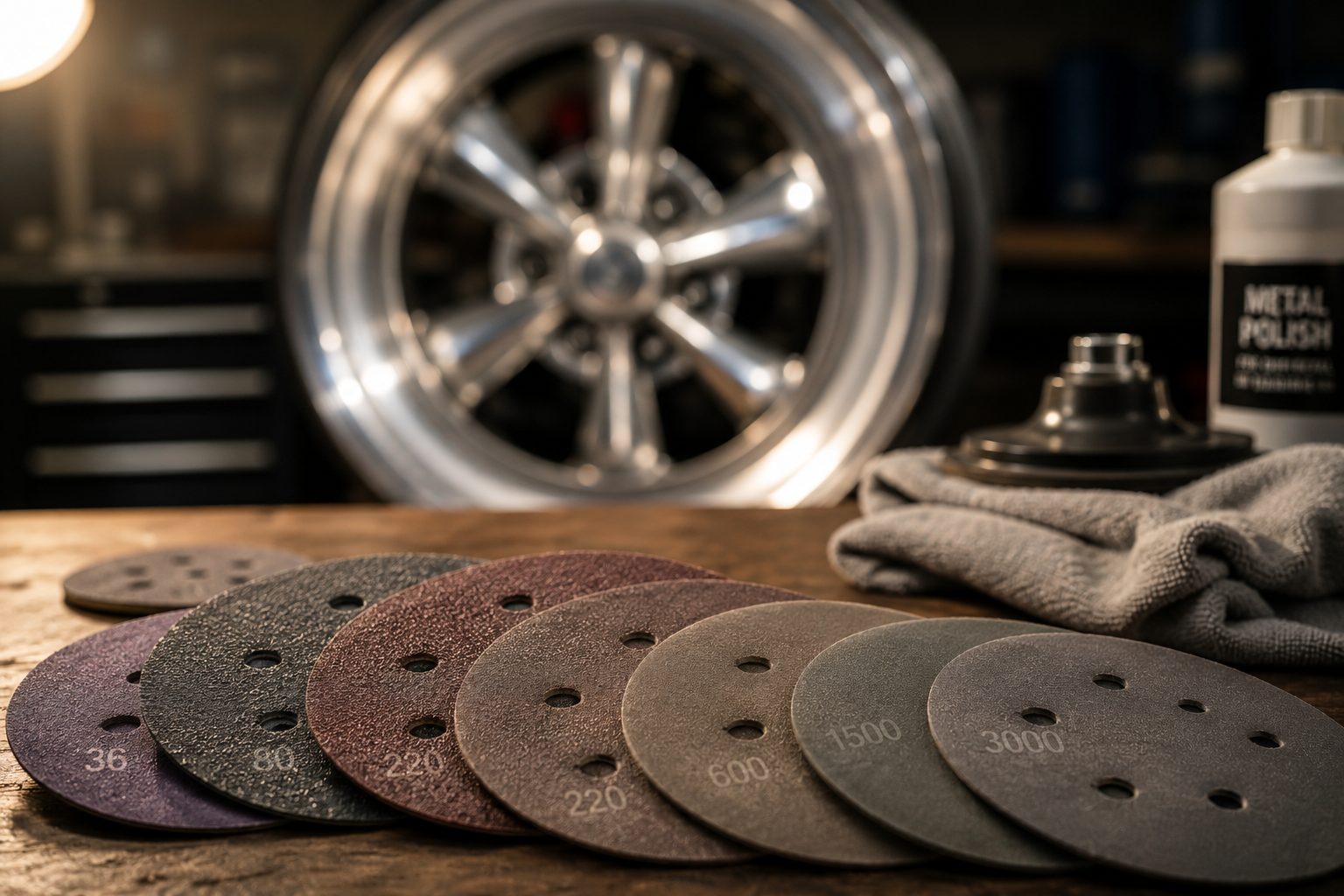
Sandpaper is measured by grit. The lower the number, the more aggressive the abrasive. A sheet of 36-grit paper removes material quickly and leaves deep scratches behind. A sheet of 3,000-grit paper feels almost like ordinary paper in your hand and removes imperfections that are nearly invisible.
That range matters because the first grit has a different job than every grit that follows.
The first grit exists to eliminate the deepest imperfection.
If the wheel has a gouge from years of curb rash, you may need to begin with 36 grit to level the surface to the depth of that defect. If most of the rest of the wheel only has light oxidation, that first sanding pass will actually make the wheel look worse. Instead of one obvious gouge, you’ll now have an entire wheel covered in coarse, uniform scratches.
That’s exactly what should happen.
The first sanding pass isn’t trying to create a beautiful surface. It’s leveling the surface by correcting the deepest imperfection. Once that deepest defect has been brought into alignment with everything around it, the work changes.
Every sanding pass after that has a different purpose. You’re no longer trying to solve the original problem. Each successive grit refines the scratches left by the previous one. Every pass creates smaller, more predictable imperfections that the next pass removes.
That progression is the part I’ve come back to over and over again. You don’t jump from solving the biggest problem to the finished product. You solve the biggest problem first, then patiently refine the consequences of that correction until they, too, have been refined.
Let the work tell you when to move on
One of the things I appreciate most about wheel refinishing is that the work tells you when it’s time to move on.
You don’t advance to the next grit because you’ve spent enough time. You move on because the scratches from the previous grit are gone. The surface becomes consistently dull, and that consistency tells you you’re ready for the next stage.
One of the lessons refinishing taught me is that moving on too early rarely saves time. If you leave scratches from the previous grit behind, they almost always reveal themselves later. By then, the only real solution is to go back, remove them properly, and work through each successive grit again. The fastest path to a polished wheel is usually the patient one.
I’ve found myself thinking about that more and more outside the garage. It’s surprisingly easy to move on because a deadline says it’s time or because we’re tired of working on a problem. Refinishing has taught me that the work itself often tells you when you’re ready to continue—if you’re paying attention.
There’s another part of the process that took me much longer to appreciate.
Choose the finish before the first grit
You don’t decide where to start without first deciding where you’re trying to finish.
The aluminum wheels on my work truck require a very different finish than the wheels on one of my show cars. On the truck, I might stop after sanding to 600 grit. The remaining imperfections are appropriate for a truck that’s meant to be used. On a show car, I may continue sanding through 3,000 grit or beyond before ever reaching for polishing compound. Neither approach is better. They simply reflect different goals.
The finish should match the purpose.
That idea has changed the way I think about improvement generally. Not every project requires the same level of refinement. Sometimes the right answer is simply the finish that best serves the work you’re trying to do.
It took me an embarrassingly long time to realize that polishing compound is really just another abrasive.
At some point we stop saying we’re sanding and start saying we’re polishing, but the work hasn’t fundamentally changed. Polishing compounds are simply incredibly fine abrasives suspended in a liquid. You’re still refining the surface. You’re simply working at a much finer scale.
The final step reveals the work
One part of the process still sticks with me.
After hours of sanding, you’ve worked through grit after grit. You’ve removed the deepest imperfection. You’ve leveled the surface. You’ve refined the scratches left by each successive sanding pass. Objectively, almost all of the work is finished.
And the wheel still doesn’t shine.
The first few times I refinished a wheel, I remember looking at that dull, uniform surface and wondering whether all those hours had actually accomplished anything.
Then you apply polishing compound.
Within moments, the reflection begins to appear.
It’s tempting to think that the polishing compound created the shine.
It didn’t.
The shine was the cumulative result of every sanding pass that came before it. The polishing compound simply revealed the surface those earlier steps had been patiently preparing all along.
I think that’s why this process has stayed with me for so many years.
It’s easy to celebrate the visible transformation because that’s the part everyone notices. But the visible transformation is rarely where most of the work happened. The final step reveals the result. It doesn’t deserve all the credit.
The questions I carry with me
When I find myself trying to improve almost anything now, I eventually come back to the same questions.
-
Is the foundation sound?
-
What’s the deepest remaining imperfection?
-
What level of finish does this actually require?
-
And what grit should I begin with?
Those questions don’t give me the answers. What they do is slow me down long enough to understand the work before deciding how to improve it. More often than not, that turns out to be the shortest path to the outcome I was hoping to achieve.
Refinement isn’t about making everything perfect.
It’s about understanding what something is capable of becoming, correcting the deepest imperfection first, leveling the surface, and then patiently refining the consequences of each step until the finish matches the purpose.
Or, to borrow the shorthand I’ve started using with myself:
What grit does this require?