Keeping Humans Centered in How We Build and Decide
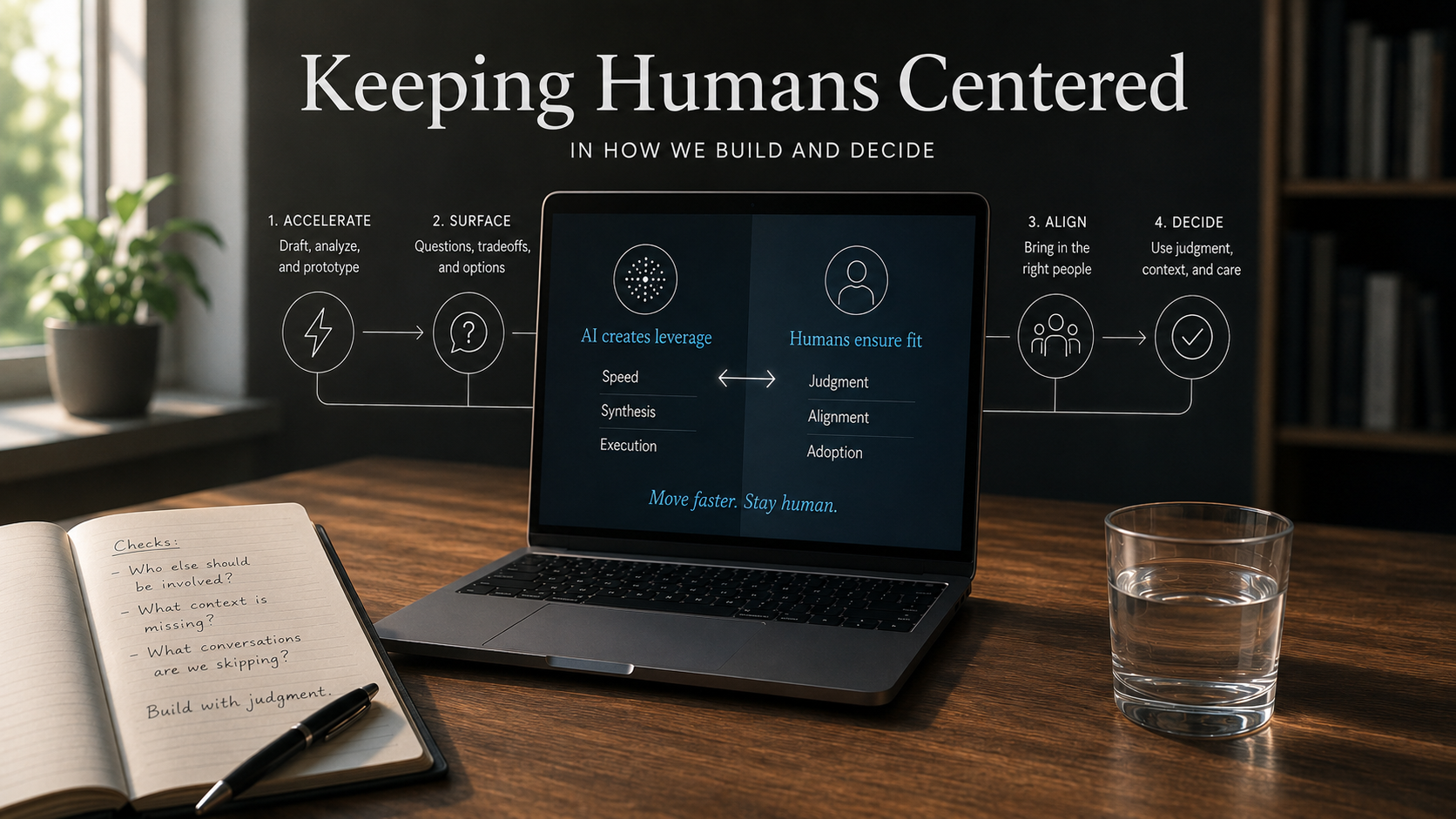
And why I'm focused on that and much less concerned about AI itself...
I've been spending a lot of time recently thinking about how AI is showing up in day-to-day work. In many cases, it's genuinely helpful.
I see people using it to:
- draft and refine communication
- wrangle large data sets to shift the conversation from "What does the data say?" to "So what are the implications?"
- build lightweight tools or workflows that didn't previously exist
And in those moments, it's doing something important: it's giving back time that can be redirected toward the parts of work that actually require judgment, experience, and relationships.
I have little interest in debating whether AI is coming. It's already arrived, and organizations have too much to accomplish to ignore it as a tool in the toolbox. What interests me is how organizations make decisions about when and how to leverage AI in ways that optimize for outcomes, sustainability, and for the people doing the work.
I think it's worth saying more precisely:
AI can give time back - but it can also expand what feels possible without changing how much time, organizational capacity, or context we actually have.
I've started to notice that the same tools that give us leverage also make it much easier to skip steps that used to matter.
For example -
This year, I overhauled parts of our contracting process and CRM. A few years ago, this would have required outside engineering support or waiting on capacity we didn't have. Instead, I was able to build it myself - using AI to help write and refine code along the way. The ability to build something like this myself is entirely new. And the result will make the system more usable for our team.
But I'm also working on another project - a planned work calendar inside that same system. In that case, I made a different choice. I could have built it quickly in a similar way. Instead, I used AI to help draft a project brief - something we could share with the teams this work will affect.
We're now using that to:
- gather input
- surface questions
- make sure people understand what's being built and why
There will also be pilots and testing before anything is finalized.
Both of these approaches use AI. But they lead to very different processes.
One accelerates execution on something relatively well understood. The other creates space for shared understanding before anything is built. That distinction has started to matter more to me than the tools themselves.
AI now makes it possible for individual contributors to do much more on their own.
But it doesn't necessarily give them:
- more time in the day
- more context for decisions that affect others
In some cases, it simply expands the scope of what feels possible without changing the constraints around judgment, alignment, or impact.
There's another layer to this that I've been circling...
As operators, we're used to evaluating work across some consistent dimensions: risk, resources, time, and impact.
There's a category of work that often sat just below the line - important enough to name, but not important enough to prioritize or resource.
Sometimes that was about budget.
But often it was about the effort surrounding the work:
- the time it would take
- the number of people it would involve
- the coordination required to get it right
If something crossed that threshold, it became a different kind of decision.
It required clearer articulation of the problem, input from others, and a shared understanding of what success looked like. Not because we were perfectly disciplined, but because the effort forced us to be.
AI changes that.
Some of that same work can now be done by a single contributor in a fraction of the time, without needing the same level of coordination.
A new tool... A revised framework... A redesigned workflow...
Things that might once have taken a team 100 hours can now be produced by one person in a couple of days.
And that's where I've been getting stuck. Because removing those constraints doesn't just make work easier. It also removes the friction that used to force prioritization and collaboration.
So the question I keep coming back to is:
What is the cost of "free" work when it skips the alignment we used to rely on to get it right?
I don't think the answer is to slow everything down. In many cases, the ability to move quickly is exactly the value AI creates. But speed isn't the only thing organizations optimize for. We also care about judgment, alignment, adoption, and sustainability. The challenge is understanding when faster execution creates value and when human involvement improves the outcome.
For me, this has started to show up less as a rule and more as a set of checks. Not to slow everything down - but to be more intentional about when speed is actually the goal.
A couple of questions I've been using:
- If AI didn't make this easy to do alone, who else would I be involving?
- And if this used to require meaningful time or coordination, what conversations are we now skipping by doing it this way?
I don't think this is about avoiding AI. It's also not about forcing every decision into a group process. It's about being more deliberate about when individual execution is enough - and when the work benefits from being shaped together.
The more time I spend with these tools, the less interested I become in questions about whether AI can help us work faster. In many cases, it clearly can.
The questions I'm increasingly drawn to are organizational ones:
- Where does speed create value?
- Where does human involvement improve outcomes?
- What happens when technology removes constraints that were quietly helping us make better decisions?
I'm still working on how to make this more usable across a team, not just as an individual instinct.
If you're navigating this in your own work:
- Where has AI clearly improved how things get done?
- Where does it risk skipping something that actually matters?