The Most Likely Answer Is Not Always the Right One
One of the most immediately useful things about AI today is how quickly it can produce competent work.
It can draft an email, propose policy language, summarize a meeting, organize a project brief, frame an analysis, or suggest a workflow. In a matter of minutes, it can generate something clear, polished, and often quite usable.
For anyone whose impression of AI was formed even a few years ago by texting with a chatbot, the growing competency and complexity of current outputs can be startling. Work that once began with a blank page, several rounds of revision, or a long search for a viable approach can now begin with a plausible answer, solution, or work product after a single prompt.
That does more than accelerate the work. It can change where the task complexity lives—and where organizations need to focus their energy.
When AI gives you, or someone on your team, an answer that works in general, how do you determine whether it is effective for your organization?
That question is becoming increasingly important because AI outputs are often not obviously wrong. They may be reasonable, coherent, professionally written, easy to defend—and not actually helpful at all.
As AI becomes more common across teams, the work increasingly shifts from producing a plausible first draft to understanding what it assumes, what it misses, and what must change to meet your organization’s actual needs.
Why the first answer often feels familiar
At its core, a large language model generates a response by predicting what is most likely to come next based on patterns in the material it was trained on and the context you provide.
That makes it very good at producing outputs that feel directionally correct.
It has encountered patterns across millions of communications, policies, plans, analyses, and websites. When you ask it to create something, it draws from those patterns to produce a statistically plausible response.
Without enough direction, that response will often move toward the most common version of the thing you requested—the version most strongly represented in the patterns it learned.
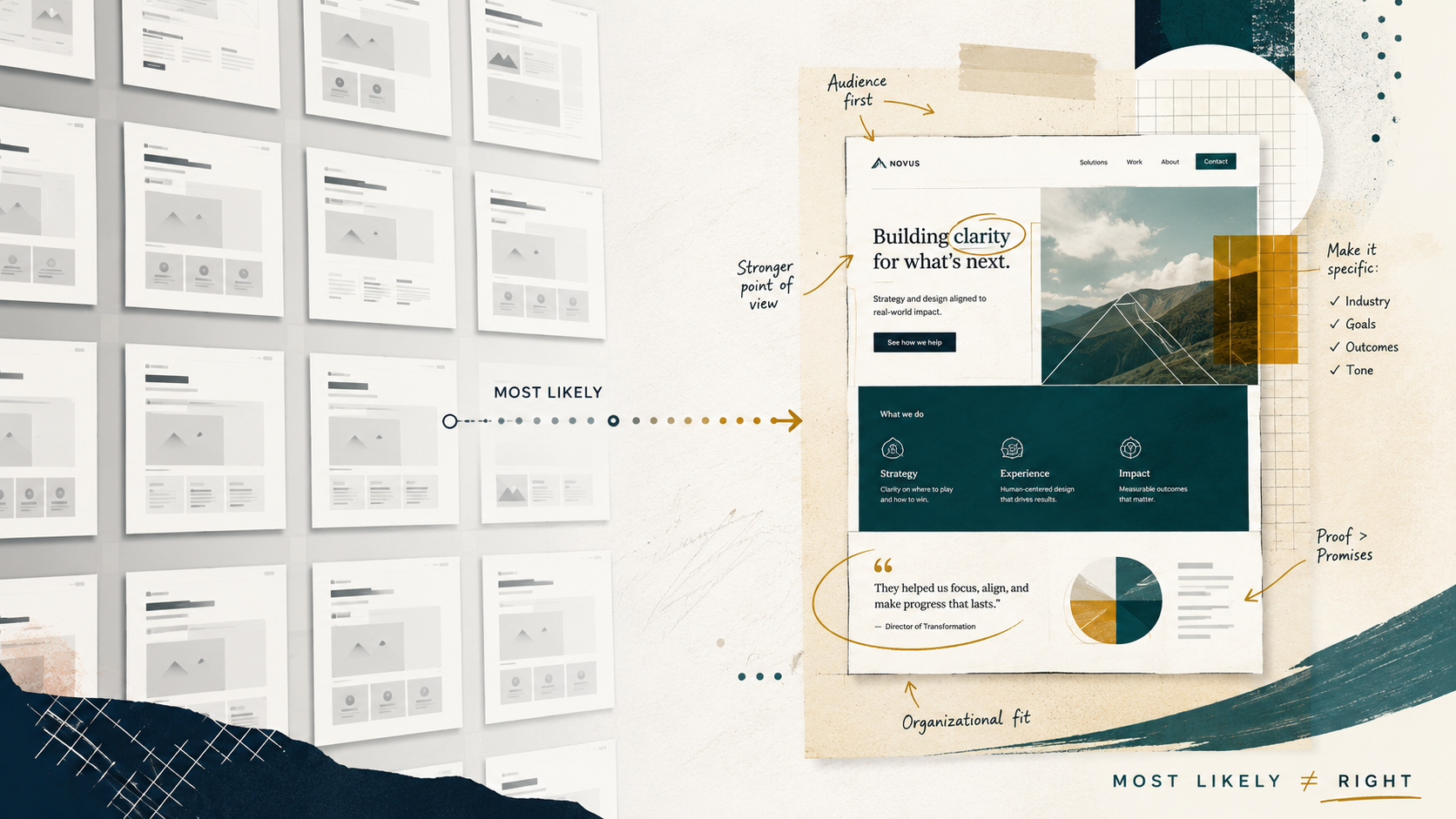
Ask an AI tool to design a modern website without much additional guidance, and it will likely produce something that looks familiar: a large headline, clean sans-serif type, generous white space, a prominent call to action, and a sequence of rectangular content sections.
It may look a lot like a standard Squarespace template.
That does not necessarily mean AI has failed. That design language is prevalent across the modern web. It is a highly recognizable answer to the request for a modern website.
The result may be attractive, functional, and professionally shaped.
But it has not yet answered the more important questions.
What should this site communicate? Who needs to trust it? What makes your organization distinct? What action should visitors take? What can your organization realistically maintain?
The most likely version of a modern website is not automatically the most appropriate or useful website for your organization.
The same pattern appears in many initial responses generated by AI.
AI can blur common and appropriate
Because a large language model generates from patterns, its first response will often reflect what is recognizable, frequently used, or broadly recommended.
That can blur three different ideas:
- What is done most often.
- What is generally considered best practice.
- What is appropriate for your context.
AI may present any of these with the same confidence and polish. It does not automatically distinguish between a common answer and one that accounts for your organization’s actual goals, relationships, resources, or constraints.
Common practice may reflect habit rather than quality. Best practice may assume capabilities or conditions that do not exist in your organization. An appropriate solution may need to depart from both because of something particular to your organization or context.
A polished email can still use the wrong tone. A thorough policy can still create unnecessary friction. An analysis can accurately answer the question asked while missing the decision that actually needs to be made.
Operational leaders have to help teams recognize whether AI is offering a generically useful response or something that would actually work within the organization.
Common patterns and best practices are useful inputs. They are not conclusions.
The work is in the judgment
It is tempting to think of human review as the final quality-control step in an AI-enabled process: the tool creates the output, someone checks for errors, and the work moves forward.
But operational leaders have to ensure that this review is treated as more than proofreading.
The people using AI across your organization need to be able to identify the assumptions embedded in its responses.
- What audience is it imagining?
- What outcome is it optimizing for?
- What resources does it assume are available?
What does it treat as a standard situation that may actually be unusual in your organization?
What organizational history, relationship context, or practical constraint is missing?
The first answer may be technically sound but too generic. The next may incorporate the organization’s constraints while still missing the relationship dynamics. Another round may better reflect the audience but optimize for speed when the work requires trust or adoption.
The process is iterative because the person using AI is gradually bringing more of the organization’s context into the work.
AI can revise quickly. But it cannot account for context it has not been given, and it may interpret the context it receives differently than intended.
The person using the tool has to recognize that gap and explain what needs to change.
That judgment comes from knowing the organization well enough to recognize what the model cannot infer from the prompt alone—and helping teams bring that knowledge into how they use AI.
What to ask next
AI can produce a plausible first response quickly because it can draw from a vast set of common patterns.
That is a powerful starting point.
But the first response should prompt a different set of questions:
- What common pattern is this answer drawing from?
- What does it assume about our audience or organization?
- What important context is missing?
- What is it optimizing for?
- What would have to change for this to be appropriate here?
- What should I add, clarify, or challenge in the next prompt?
The most likely answer may be useful.
But likelihood is not the same as appropriateness, and a plausible first response is not the end of the work. It is closer to the beginning.