Improve. Redesign. Reimagine.
“Use AI” is not a strategy. Map each initiative by the organizational change it should create: Improve, Redesign, or Reimagine.

A Framework for Mapping AI-Enabled Organizational Change
Leaders are under growing pressure to explain how their organizations are leveraging AI. That pressure is understandable. AI may prove to be one of the most significant technological shifts in decades.
But “use AI” is not an organizational strategy.
In the long run, leaders will be judged by the outcomes they create, not the tools they adopt. AI matters because it may be one of the most powerful new levers available for changing what organizations can accomplish.
Today, many organizations place every opportunity involving AI into a single bucket labeled “AI initiatives.” That framing often obscures two important questions: What change is the initiative actually intended to create? And how does that change advance the organization’s goals and outcomes?
I will occasionally use the phrase “AI initiative” because it reflects how many organizations currently discuss this work. But the purpose of this framework is to shift the focus from AI itself to the change being proposed. The most important question is not whether an initiative uses AI. It is what AI is helping the organization accomplish.
| Category | What stays the same | What changes | Leadership question |
|---|---|---|---|
| Improve | The purpose and recognizable task | Speed, accuracy, consistency, or sustainability | Does the work still need to be done, and did AI improve the outcome? |
| Redesign | The broad outcome | The workflow across people, systems, handoffs, and decisions | Who owns the new workflow, and how will exceptions be handled? |
| Reimagine | The strategic goal | A new service or organizational ability comes within reach | Should the organization pursue and sustain this new possibility? |
I find it useful to map these initiatives according to three categories:
- Improve existing work.
- Redesign how work happens.
- Reimagine what the organization can accomplish.
These categories do not map to the three modes of AI-supported work. Search, Task, or Collaborative use can support an Improve, Redesign, or Reimagine initiative; the mode names AI’s role in the work, while the category names the change being pursued.
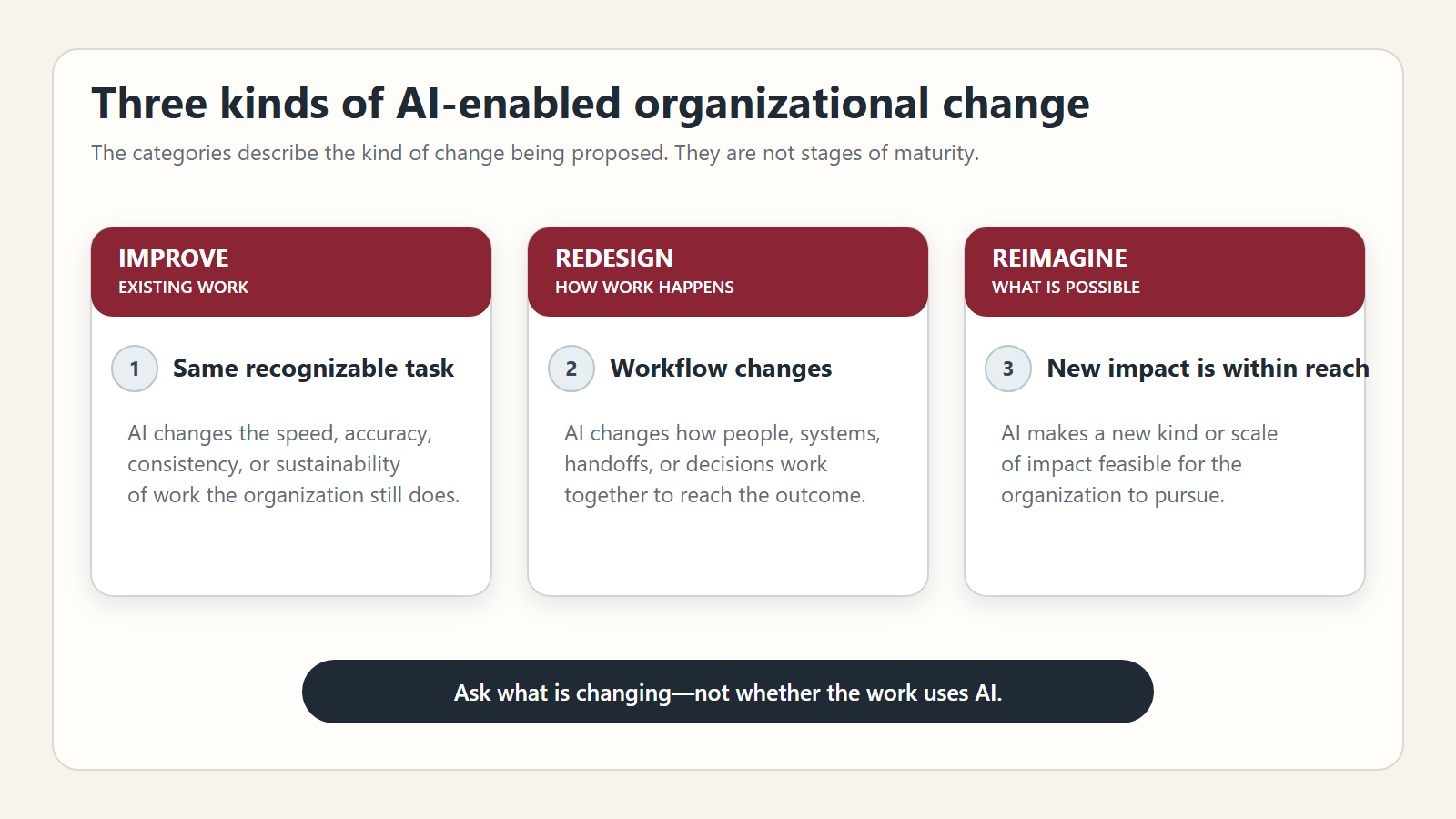
The thinking behind this framework was influenced by the Three Horizons model of innovation, Steve Blank’s evolution of that model in Harvard Business Review, and LearnerStudio’s application of horizon thinking to learning in the age of AI. I am not applying any of those frameworks directly. I am borrowing the underlying idea that leaders benefit from distinguishing among different kinds of change.
Improve existing work
The first question is whether the work remains fundamentally the same.
If the organization is still completing the same task but AI changes how efficiently, consistently, or effectively it completes that task, the initiative belongs in Improve.
The task does not have to remain untouched. AI may perform several intervening steps, move the work into a new system, or enable the organization to build a tool that completes part of the process automatically. What matters is that the work would still be described in essentially the same way.
The organization is still reviewing contracts, reconciling transactions, processing applications, preparing forecasts, or responding to service requests. AI changes how that work is performed, not the purpose of the work.
Examples might include:
- A legal or operations team implements AI-supported contract review to identify nonstandard terms, compare agreements against approved language, and prepare issues for human review.
- A finance department uses AI to match transactions with supporting documentation, identify likely coding errors, and flag exceptions that require attention.
- A program or compliance team uses AI to review high volumes of documentation against established requirements and surface missing or inconsistent information.
These are intentional changes to how recurring work gets done. They may require shared tools, approved processes, data access, training, quality controls, and decisions about when human review remains necessary.
Improve initiatives can shorten cycle times, increase capacity, improve consistency, reduce avoidable errors, and return staff time to work that depends on context, judgment, or relationships.
They can also create value at a scale that makes the word “improve” sound deceptively modest. Reducing the effort required for a high-volume task may have a larger organizational impact than a more novel experiment elsewhere in the portfolio.
Efficiency alone is not proof of value. Leaders still need to test whether the result fits this organization and situation.
AI can help an organization produce unnecessary work faster, increase the volume of low-value output, or optimize a step that should have been removed. An Improve initiative still needs a clear connection to an outcome the organization values.
Leaders should ask:
- Does this work still need to be done?
- Did the change improve how efficiently, accurately, or sustainably the organization reaches the intended outcome?
- What new risks or review requirements did the change create?
- How will the organization know whether the gain is worth sustaining?
In an Improve initiative, the task remains recognizable. AI changes the organization’s ability to perform it.
Redesign how work happens
The next question is whether accomplishing the goal requires the workflow itself to change.
If AI changes how work moves across people, systems, handoffs, and decisions, the initiative belongs in Redesign.
The organization may still be pursuing the same broad outcome. It may still be supporting customers, onboarding employees, approving purchases, or helping staff find information. But the path to that outcome changes.
Consider an intake process. An Improve initiative might use AI to classify incoming requests and recommend responses to the staff members reviewing them. A Redesign initiative might move the first interaction to an AI-enabled assistant that answers common questions, directs people to relevant resources, gathers required information, and routes more complex issues to the right person.
The goal of providing support remains. The workflow does not.
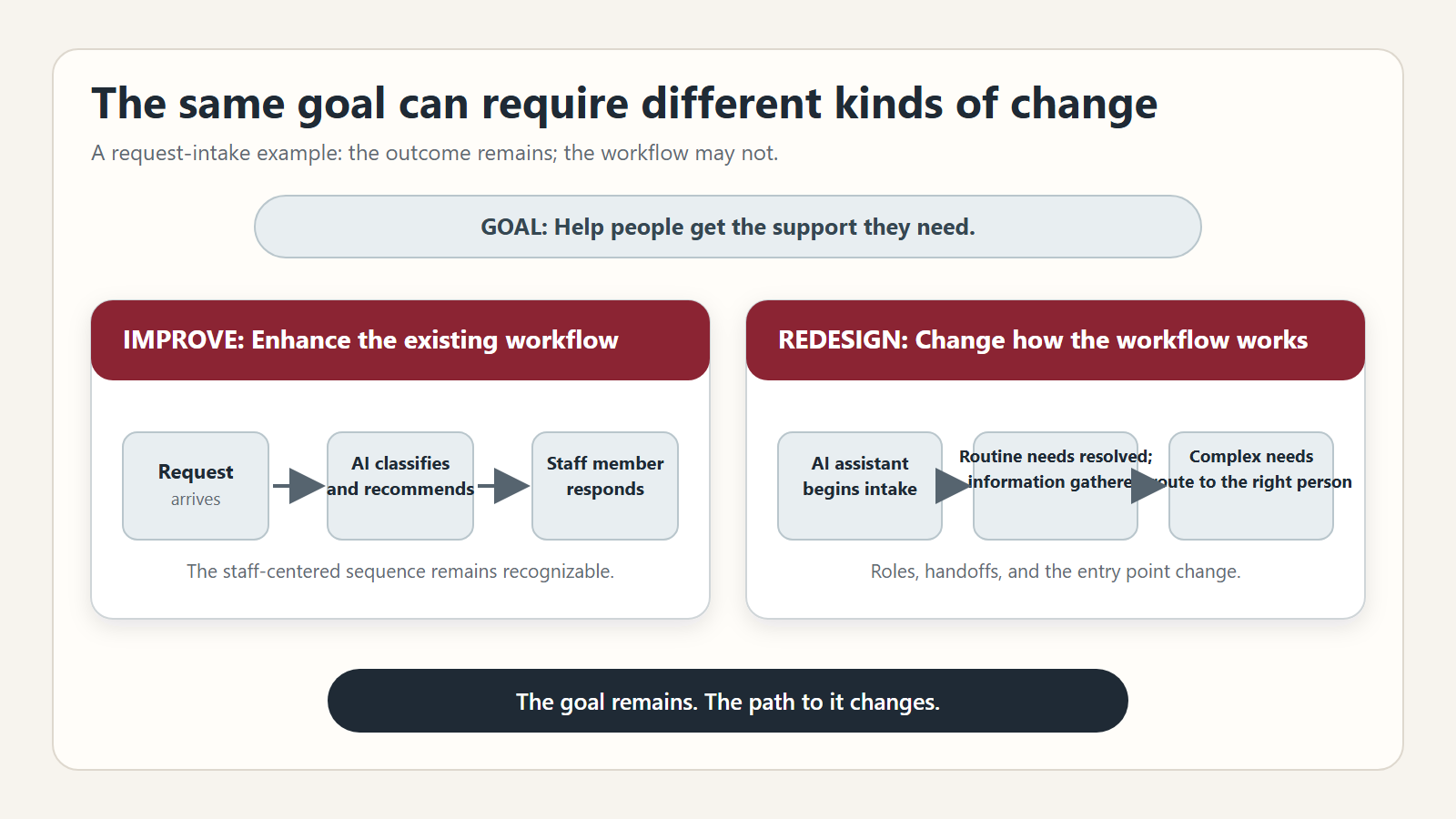
Other examples might include:
- An employee onboarding process moves from a standard sequence of emails and meetings to an AI-assisted experience that responds to an employee’s role, progress, and questions while directing human attention to moments that require judgment or connection.
- A knowledge-management process shifts from searching folders and static repositories to asking questions through a governed conversational interface that retrieves approved information and identifies gaps in the organization’s knowledge base.
- A procurement process uses AI to review requests for completeness, apply established risk criteria, route approvals based on the type of purchase, and give requesters visibility into what is needed next.
In each example, AI does more than accelerate a step. It enables the organization to reconsider where the work begins, which interactions require a person, what information is collected, when decisions occur, and how exceptions move through the system.
That makes Redesign an operating change, not simply a technology implementation.
The tool may be necessary, but it is not sufficient. Leaders still have to decide who owns the new workflow, how responsibilities shift, where human review remains essential, what happens when the system is wrong, and how the process will be maintained after launch.
The people affected by the workflow need to understand more than how to use the technology. They need to understand why the process is changing, what the new process asks of them, and how their work connects to the intended outcome.
Redesign initiatives often fail when organizations treat functioning software as evidence that the change is complete. A new workflow becomes real only when people adopt it, exceptions can be handled, ownership is clear, and the organization can sustain the new way of working.
Leaders should ask:
- Which roles, handoffs, or decision points will change?
- What work moves from people to AI, and what should remain human?
- Who owns the performance of the full workflow?
- How will exceptions, errors, and escalations be handled?
- Does the redesigned process produce a better experience or outcome?
In a Redesign initiative, the purpose of the work may remain familiar. AI changes how the organization coordinates and delivers it.
Reimagine what the organization can accomplish
The final question is whether AI makes it possible for the organization to offer a new service or develop an organizational ability it could not previously sustain.
Reimagine initiatives do more than improve an existing task or redesign the workflow around a familiar outcome. They expand what the organization is capable of doing in service of its goals.
The idea itself may not be new. Leaders may have imagined it before but lacked the staffing, technology, information, or operating capacity required to make it viable. AI changes the economics enough to bring it within reach.
Examples might include:
- An organization provides personalized guidance at a scale that previously would have required one-to-one access to a specialist.
- A product or service adapts continuously to the information, choices, or progress of each user rather than delivering the same fixed experience to everyone.
- A leadership team gains an ongoing simulation and scenario-planning capability that combines large amounts of information, tests assumptions, and helps the organization respond to changing conditions.
The defining feature is not that the technology is more advanced. It is that the organization can now pursue a kind or scale of impact that was previously out of reach.
These new services and organizational abilities also create new expectations. A personalized service may require standards for quality and escalation. An adaptive product may require continuous improvement and support. A new decision-support ability may alter who has access to information, how choices are made, and where accountability sits.
AI may make a new service or organizational ability possible, but it does not automatically create the organizational capacity to operate and sustain it. That capacity still depends on clear ownership, sound judgment, ongoing maintenance, and enough time and attention to respond when the service falls short or conditions change.
Reimagine initiatives therefore raise questions that extend beyond implementation. Leaders need to consider whether the new service or organizational ability advances strategy, whether people need it, what expectations it will create, and what the organization must learn or maintain to deliver it responsibly.
Novelty is not evidence of value. Neither is technical feasibility.
Leaders should ask:
- What kind or scale of impact is now within reach?
- How does the new service or organizational ability advance a strategic goal or desired outcome?
- Who will use or benefit from it, and what evidence shows that they need it?
- What new expectations, risks, or obligations will it create?
- Can the organization operate and maintain the new service or organizational ability after the initial build?
In a Reimagine initiative, AI does not simply change the task or the workflow. It changes what the organization can realistically attempt.
A portfolio, not a ladder
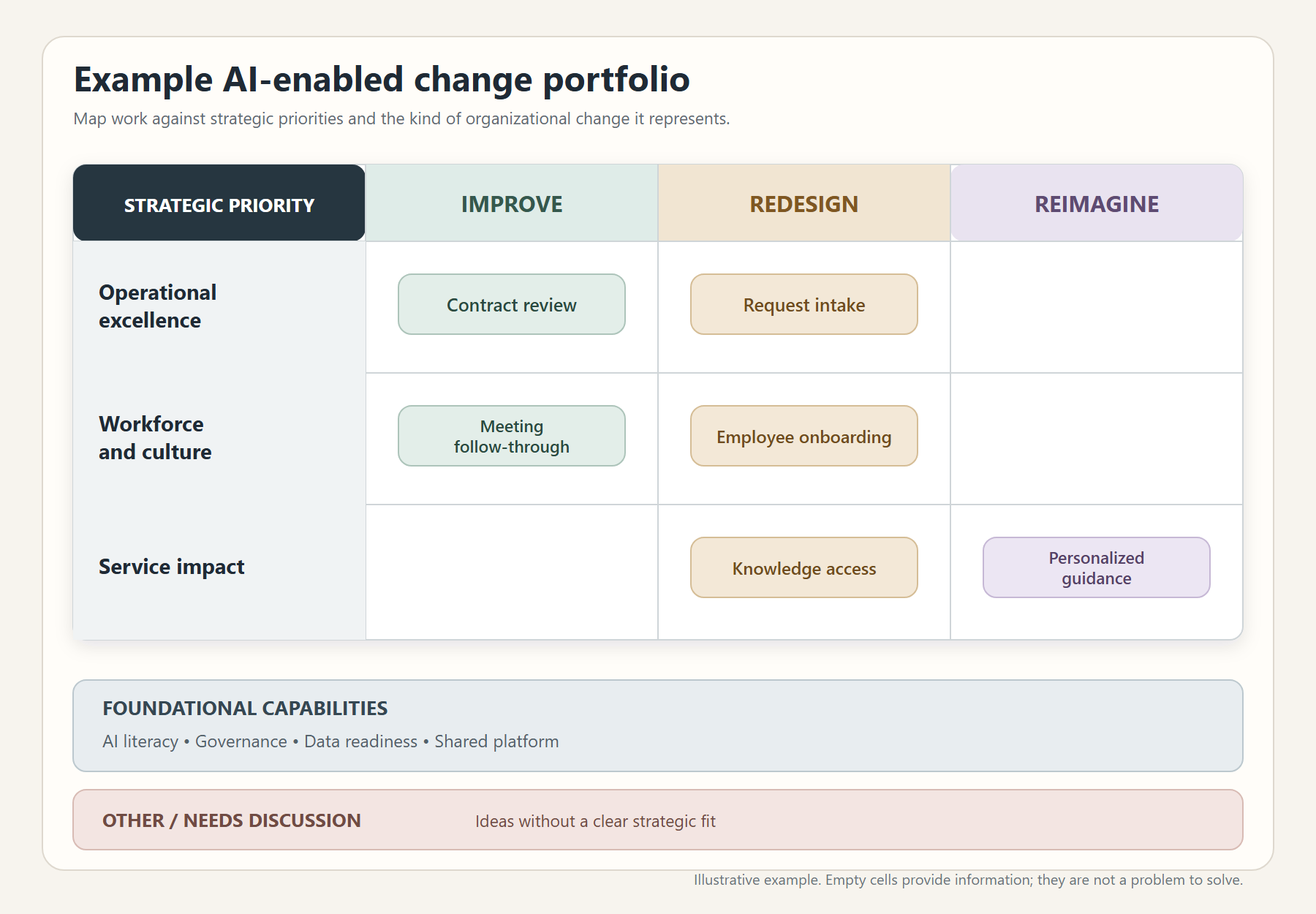
Improve, Redesign, and Reimagine are different kinds of change, not stages of maturity.
An Improve initiative may create more value than a novel experiment by strengthening high-volume work. A Redesign initiative may require greater leadership attention because it changes how people, systems, and decisions fit together. A Reimagine initiative may bring a new kind or scale of impact within reach while creating new demands on organizational capacity.
There is no ideal distribution across the three categories. The right mix depends on the organization’s strategic vision, needs, capacity, and appetite for change.
AI deserves sustained leadership attention because of the leverage it may provide. It can reduce the effort required for existing work, enable different operating models, and bring new kinds or scales of impact within reach.
But “use AI” is not an organizational strategy. The leadership task is to decide where that leverage should be applied and what outcomes it should serve.
The most important question is not whether an organization has enough AI initiatives. It is whether its distribution of effort and focus reflects its strategic vision, needs, and capacity.
A companion guide, Map Your AI-Enabled Change Portfolio, explores how to apply the framework in practice.
Foundational series
Previous idea: A Better Question Than “Are We Using AI?”
Next idea: The Most Likely Answer Is Not Always the Right One
Apply it: Map Your AI-Enabled Change Portfolio