A Better Question Than “Are We Using AI?”
“Using AI” is too broad to guide leadership. The same tool can help us know, do, or figure out what comes next—and each mode needs different human responsibility.
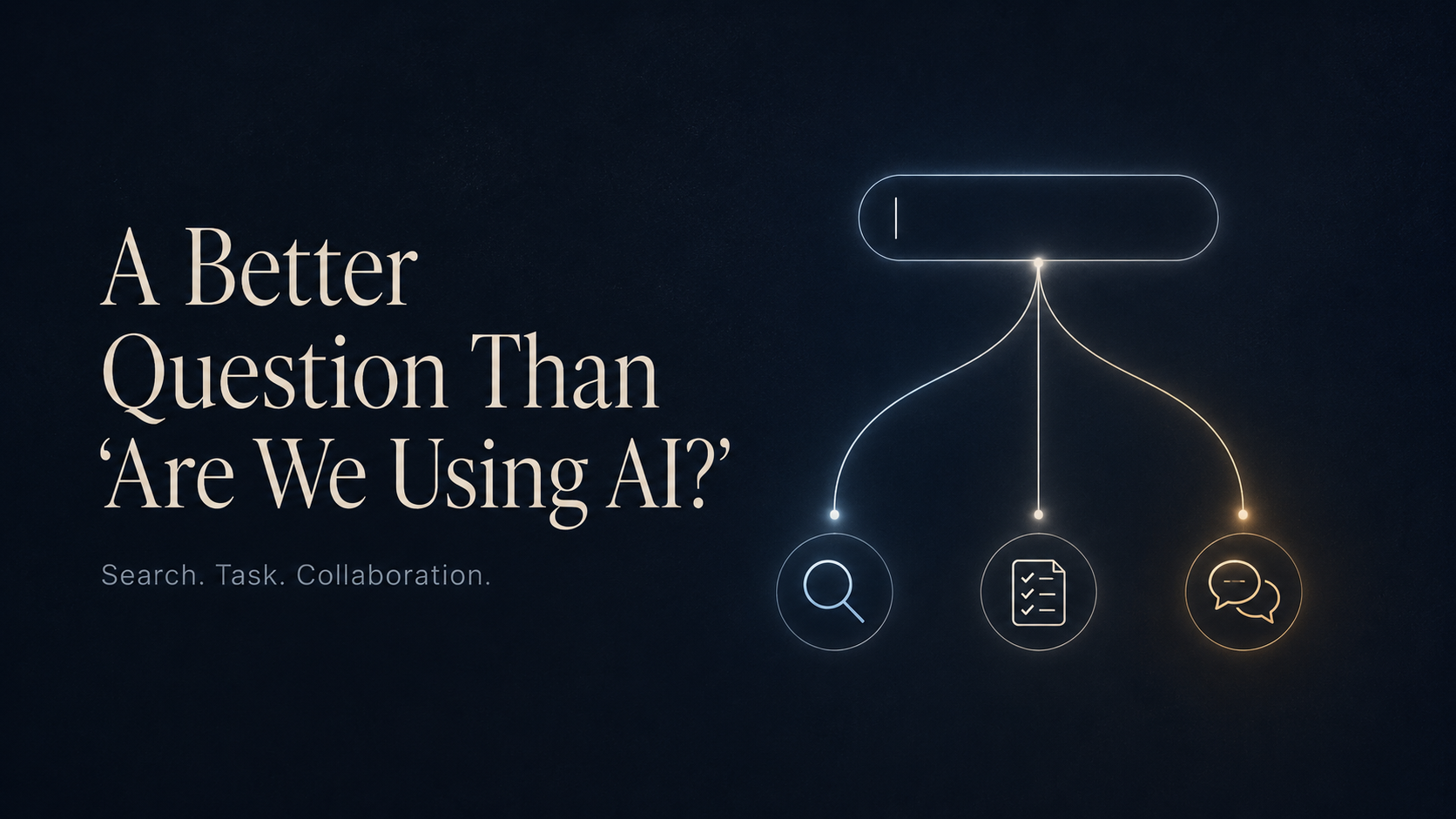
Search helps us know. Task helps us do. AI as collaborator helps us figure out what comes next.
One of the challenges with talking about AI at work is that we use one phrase — “using AI” — to describe a lot of different things. The same leader can sit down with the same AI tool and ask it to find background information, compare examples, analyze a spreadsheet, draft a communication, or help work through an idea that is not yet fully formed. From the outside, all of that may get described the same way: someone used AI. But the tool is not the most important distinction. The work is.
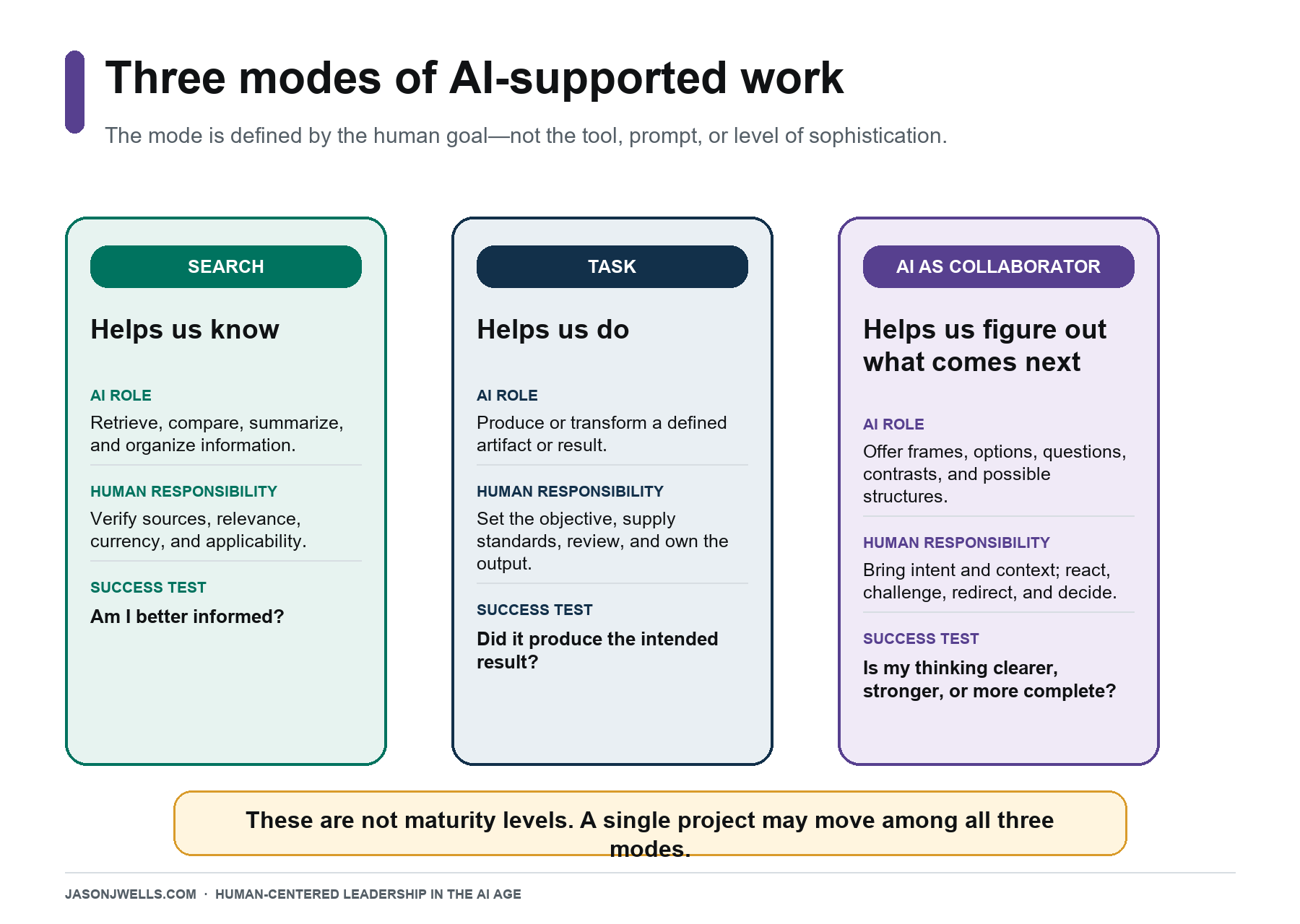
For leaders, that distinction matters because different kinds of AI-supported work require different kinds of human responsibility. They create different kinds of value, carry different risks, and require different review habits. I’ve found it helpful to separate those uses into three modes: Search helps us know. Task helps us do. AI as collaborator helps us figure out what comes next. These are not levels of sophistication, stages of maturity, or categories of tools. They are modes of work, and a single project may move among all three. The point is not to label every prompt. The point is to understand what role AI is playing in the work at a given moment.
| Mode | Goal | AI role | Human responsibility | Success test |
|---|---|---|---|---|
| Search | Know | Retrieve, summarize, compare, and organize information | Verify credibility, currency, relevance, and applicability | Am I better informed? |
| Task | Do | Produce or transform a defined artifact | Set the direction and success criteria, then review the result | Did AI help produce the intended result? |
| AI as Collaborator | Figure out what comes next | Generate frames, questions, options, and tradeoffs | Supply context, challenge the output, and own the direction | Is my thinking clearer, stronger, or more complete? |
The mode is not the tool or the verb
One reason this gets confusing is that the same surface action can appear in more than one mode. Summarizing is a good example. If I ask AI to summarize several AI acceptable-use policies so I can understand how other organizations approach the issue, I am using it in Search mode. The summary is helping me get oriented. If I ask AI to turn meeting notes into a concise update for the leadership team, I am using it in Task mode. The summary is producing a defined artifact for a specific audience.
The operation may look similar, but the role it plays in the work is different. The mode depends on what the human is trying to accomplish: understand something, produce something, or figure out what the work should become.
Search helps us know
In Search mode, the primary goal is to improve what the human knows or can access. AI might retrieve information, search across documents, summarize sources, compare examples, identify relevant background, or organize findings into something easier to use. This matters because the basic experience of finding information is already changing. A recent analysis found that more than two-thirds of Google searches ended without a click.* And that is not just a change in user behavior. Search itself is increasingly being redesigned around AI-generated answers, summaries, and follow-up questions.
In other words, AI is not simply speeding up the old pattern of searching, clicking, reading, and comparing sources. It is changing the pattern. That can give leaders a first map of the terrain quickly. It can also make the map feel more complete than it is. Search does not decide what matters. The human still has to determine whether the information is credible, current, relevant, and applicable. They have to know when a summary is enough and when the original source needs to be reviewed.
The success test for Search is not whether AI produced a clear answer. The better question is: Am I now better informed? A clean summary can feel like understanding before the human has checked the sources, noticed what was omitted, or decided whether the information actually applies. Search helps us know, but it does not relieve us of the responsibility to decide what knowledge is trustworthy and relevant.
Task helps us do
In Task mode, the human has a sufficiently clear objective, scope, or intended artifact, and AI helps execute against that direction. This might look like drafting an email, turning meeting notes into a follow-up message, generating a formula, rewriting something in a different tone, or comparing a draft against an approved checklist. Task mode is about execution. The work may still be complex, and it may still require multiple rounds of revision. But the basic direction is settled enough that AI is helping produce or transform something.
In an AI acceptable-use policy project, Task mode begins once the organization has decided what kind of policy it wants. AI might help draft the policy language, convert leadership notes into a formal document, create a staff FAQ, or write the rollout announcement. This is where AI can expand individual execution capacity quickly. It can increase what one person is able to produce, transform, or attempt on their own. But AI can expand what people are able to produce without automatically expanding what they are able to understand, evaluate, or carry forward. This is also where leaders encounter the cost of work becoming easier to produce.
Task mode is powerful because it can remove bottlenecks and accelerate defined work. But a polished output can make the work feel more settled than it is. AI can produce the wrong deliverable very efficiently if the objective is wrong, the assumptions are weak, or the success criteria are unclear. The success test for Task mode is not whether AI completed the assignment. The better question is: Did AI help produce the intended result? Task helps us do. But doing more work faster is not the same as doing the right work well.
AI as collaborator helps us figure out what comes next
Sometimes the work is not ready to execute. The leader does not yet know exactly what they want to say, what decision they want to recommend, or how the issue should be framed. They may have observations, tensions, examples, and instincts, but the direction has not fully taken shape. That is where AI can function as a collaborator.
I mean collaborator in the structure of the interaction, not in the human sense. The AI is not accountable for the work, and it does not bring judgment, intent, or lived experience. But it can create a back-and-forth that helps the person clarify what they mean. The human brings unfinished thinking. AI generates possible structures, distinctions, questions, comparisons, and alternative framings. The human reacts, redirects, adds context, sharpens the direction, and keeps going.
In the AI policy example, Collaborative mode might happen before the policy is ready to draft. The leader may still be working through the real purpose of the policy. Is the goal to prevent misuse? Protect confidential information? Clarify approved tools? Encourage responsible experimentation? Reduce fear? Establish review expectations? Those are related questions, but they are not the same question. A policy designed primarily to mitigate risk may look different from one designed to enable safe adoption.
AI can help the leader explore those distinctions. It can compare possible approaches, surface tradeoffs, and put language around an idea that is still forming. Sometimes a misaligned response is useful because it helps the human clarify what they actually mean. But that does not make AI the source of judgment. The human still owns the direction. The success test for Collaborative mode is: Is my thinking clearer, stronger, or more complete?
Why the distinction matters
This distinction matters because “AI adoption” can conceal very different realities. Two teams might both report that they use AI regularly. One may mostly use it to search for information and summarize background materials. Another may use it to draft communications, create project plans, analyze data, and produce operational artifacts. A third may use it to explore strategy, pressure-test decisions, and develop new approaches before bringing them to others. Those are different adoption patterns, not one shared level of maturity.
Different modes also require different supports. Search may require source literacy, verification habits, and access to trusted information. Task may require clear objectives, strong examples, review standards, and agreement about where AI-generated work can be used directly and where it requires additional human review. Collaborative mode may require a different kind of discipline. People need to know how to react, reframe, challenge, and decide. They need to understand that fluency is not authority. They need to recognize when AI is shaping the frame of the conversation, not merely helping produce language.
This is why leaders need better questions than “Are people using AI?” They might ask: What are people using AI to do? Which modes are most common? Where is AI expanding individual execution capacity? Where is AI influencing analysis, framing, or decisions? And eventually: where are people becoming more capable, not just able to complete more work? That last question points to a larger issue I will return to later in this series. AI may expand capacity in ways that are useful and necessary. But leaders still have to ask whether the organization is developing the people who can understand, evaluate, and improve the work over time.
“Using AI” is too broad a category to guide leadership decisions. The same tool can help us know more, do more, or figure out what to do next. Recognizing the mode does not answer every question about quality, risk, value, or organizational fit. But it gives leaders a better place to begin. Before asking whether AI use is good or bad, advanced or basic, safe or risky, strategic or merely productive, it helps to ask a simpler question: What role is AI playing in this work? The next question is what kind of organizational change the work is pursuing.
Source note: SparkToro reported that 68.01% of Google searches in the first four months of 2026 ended without a click, based on Similarweb clickstream panel data. Google has also expanded AI Overviews and AI Mode as part of what it describes as a new era of AI Search. Other zero-click analyses vary by methodology, but the broader direction is consistent: more search experiences now resolve inside the search interface rather than through a click to an external source. Published June 2026.
Foundational series
Previous idea: Keeping Humans Centered in How We Build and Decide
Next idea: Improve. Redesign. Reimagine.