Map Your AI-Enabled Change Portfolio

Turning a list of AI ideas into a strategic conversation
Most leadership teams have a list by the time they begin sustained conversations about AI. It may include named initiatives, operational problems that AI might help solve, or ideas from a brainstorming session. Other organizations have spent months or years investing in AI-enabled work and want to understand how those efforts fit together.
A list can show what people have proposed, but it rarely shows how those ideas connect to the work the organization is trying to accomplish. This guide turns that inventory into a strategic conversation by connecting each idea to two questions:
Why does this work matter?
What kind of organizational change are we pursuing?
This framework is designed to feed your organization’s existing planning, prioritization, and governance processes. It connects AI-enabled work to strategic priorities and distinguishes among Improve, Redesign, and Reimagine.
Together, those dimensions create a clearer picture of how AI-enabled work supports current priorities and what kinds of change the portfolio emphasizes. The AI Initiative Mapping Worksheet provides a place to follow each step below.
Start where you are
Organizations enter this exercise at different points. Some are collecting ideas, while others are running pilots, implementing capabilities, or reviewing work already underway. Start with what you have and use the first worksheet to translate it into a common language.
For each item, ask:
- What organizational change is this initiative intended to create, or what problem is it intended to solve?
- How does AI support that change?
For example:
| Starting point | Organizational change | How AI supports the change |
|---|---|---|
| AI chatbot | Reduce the time employees spend searching for HR policies. | Answers routine questions and routes complex issues. |
| Meeting notes | Improve meeting follow-through and accountability. | Captures decisions and action items. |
| Contract AI | Reduce the effort required to review standard agreements. | Identifies nonstandard language and prepares agreements for human review. |
The distinction matters. “Build an AI assistant” names a technology, while “Reduce the time employees spend searching for HR policies” names the organizational change leaders intend to create.
The technology may evolve without changing the objective.
Connect the work to your organization’s priorities
Once you have described the work in organizational terms, connect each initiative to the framework your organization uses to guide investment and leadership attention.
For many organizations, that will be:
- strategic priorities or organizational goals; or
- major products or services.
This keeps AI-enabled work inside the organization’s existing strategic conversations rather than creating a parallel AI planning process.
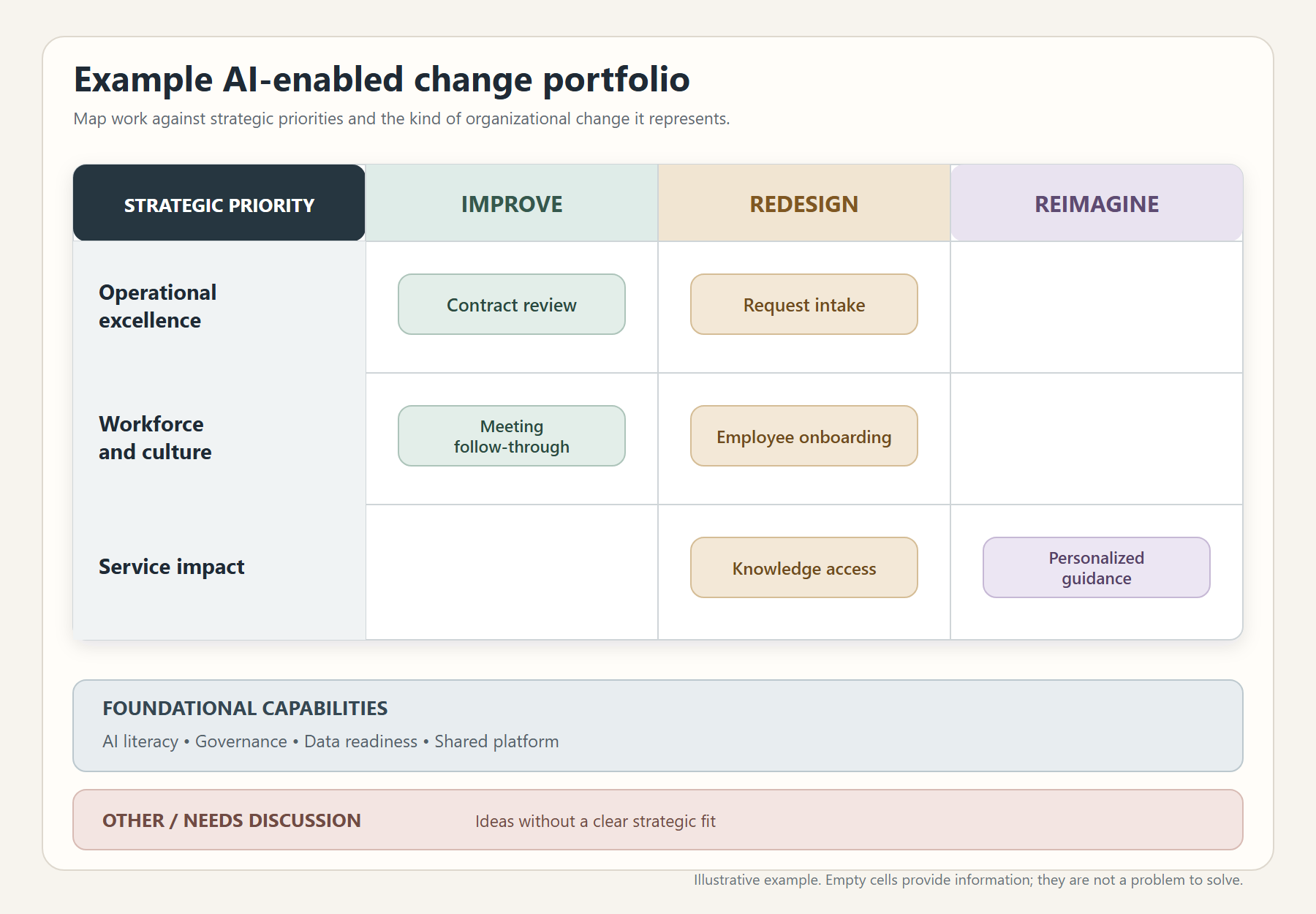
List your strategic priorities, goals, or products and services down the left side of the portfolio worksheet.
The worksheet also includes two sections outside the main matrix:
- Foundational Capabilities: Work that builds your organization’s ability to use and govern AI, such as staff AI literacy, security, data readiness, or shared platforms.
- Other / Needs Discussion: Work with no clear fit in the selected strategic framework and that requires further conversation.
These sections sit outside the three change categories. Foundational work supports the portfolio as a whole, while Other / Needs Discussion holds ideas whose strategic fit remains unresolved.
Build the portfolio
Place each initiative tied to a strategic priority into the portfolio by asking two questions:
- Which strategic priority does it support?
- What kind of organizational change does it represent?
Use the framework from Improve. Redesign. Reimagine.
| If... | Then... |
|---|---|
| The task remains recognizable, but AI changes the speed, accuracy, consistency, or sustainability of the work. | Improve |
| The workflow changes across people, systems, handoffs, or decisions. | Redesign |
| AI brings a new kind or scale of impact within reach. | Reimagine |
Some initiatives will classify quickly, while others will prompt discussion. Those conversations often reveal different assumptions about what the organization is trying to change.
A completed portfolio represents organizational change, with tool names serving as supporting detail.
Keep work that builds the capabilities needed to use AI responsibly and effectively in Foundational Capabilities. Place work with an unresolved strategic fit in Other / Needs Discussion rather than forcing it into the matrix.
Examine the portfolio before prioritizing
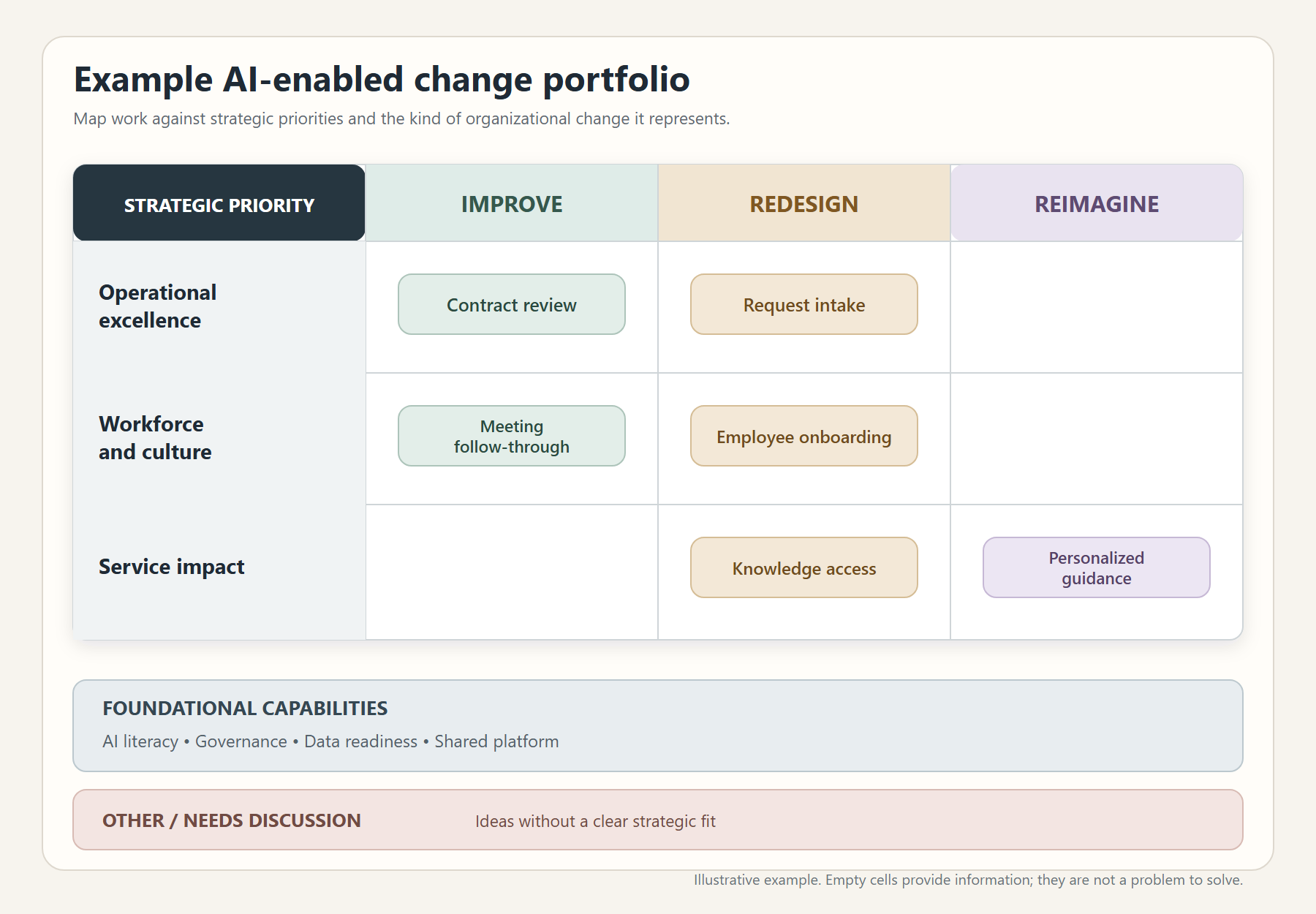
Once the portfolio is mapped, review its patterns before ranking initiatives.
Ask:
- Where is our attention concentrated?
- Which strategic priorities receive little or no AI-enabled work?
- Does our portfolio emphasize Improve, Redesign, or Reimagine?
- How much of our effort is focused on Foundational Capabilities?
- Which initiatives appear in Other / Needs Discussion, and why?
- Does this distribution reflect our strategic vision, current priorities, and organizational capacity?
A strategic map shows where AI-enabled work supports your organization. This framework adds the kind of change that work represents, revealing what kinds of innovation the current portfolio emphasizes.
A portfolio concentrated in Improve initiatives reflects a different emphasis than one concentrated in Reimagine initiatives. No one emphasis is inherently better. The right mix depends on your organization’s strategy, current needs, and capacity.
A portfolio with substantial foundational work may show that the organization is building the governance, skills, and infrastructure required to support more AI-enabled work tied directly to strategic priorities.
The map makes these choices visible so leaders can decide whether the portfolio reflects the future they are trying to build.
Leadership can then bring the work into existing planning and prioritization processes. The exercise stops before prioritization because organizations already have established ways to make those decisions. This framework strengthens the conversations that inform them.
Download the AI Initiative Mapping Worksheet
The companion worksheet includes:
- a translation worksheet for turning AI ideas into organizational change;
- a portfolio worksheet for mapping that work against strategic priorities; and
- prompts for reviewing the completed portfolio with your leadership team.
Together, the worksheets make the portfolio visible and give leaders a shared structure for discussing it.
They help your organization see how AI-enabled work supports strategy, understand the kinds of change the portfolio emphasizes, and strengthen conversations about the organization’s future.