Who Learns When AI Changes the Work?

AI can now produce a usable meeting summary before anyone leaves the room. It can create a structured record, identify decisions and action items, and do so without assigning an employee the responsibility to document the meeting. The organization gets the record it needs, perhaps faster and more consistently.
If taking notes was the employee's reason for being in the room, they may not attend the meeting at all. They lose an opportunity to practice listening for what mattered, separating discussion from decision, building relevant organizational context, and explaining the result to someone who was not there. Senior leaders may already have those skills, but the employee was still learning them.
This raises a critical question: As AI changes the work, how do organizations continue developing the people responsible for it? In The Most Likely Answer Is Not Always the Right One, I argued that people add value by recognizing an AI response's assumptions, missing context, and organizational fit. That judgment develops over time through real assignments, feedback, and exposure to experienced colleagues.
What meeting notes also teach
Creating meeting notes appears to be a straightforward assignment. Listen to the conversation and produce an accurate record of what happened. Doing that well requires a person to decide what deserves emphasis, connect the discussion to earlier work, and identify which decisions will shape what happens next.
A manager or colleague may then review the notes and ask, "Why did you choose to emphasize that?" or "What would someone who missed the meeting need to understand?" Those questions reveal how the employee interpreted the conversation. The discussion that follows sharpens the employee's analysis while teaching them who makes which decisions, which tradeoffs leaders accept, and how relationships affect the outcome.
The organization receives a record of the meeting while the person producing it practices interpreting the organization. Over time, the employee becomes better able to recognize what matters and explain why it matters to someone else. The assignment helps prepare that person for work requiring more responsibility, even if no one designed it as a developmental exercise.
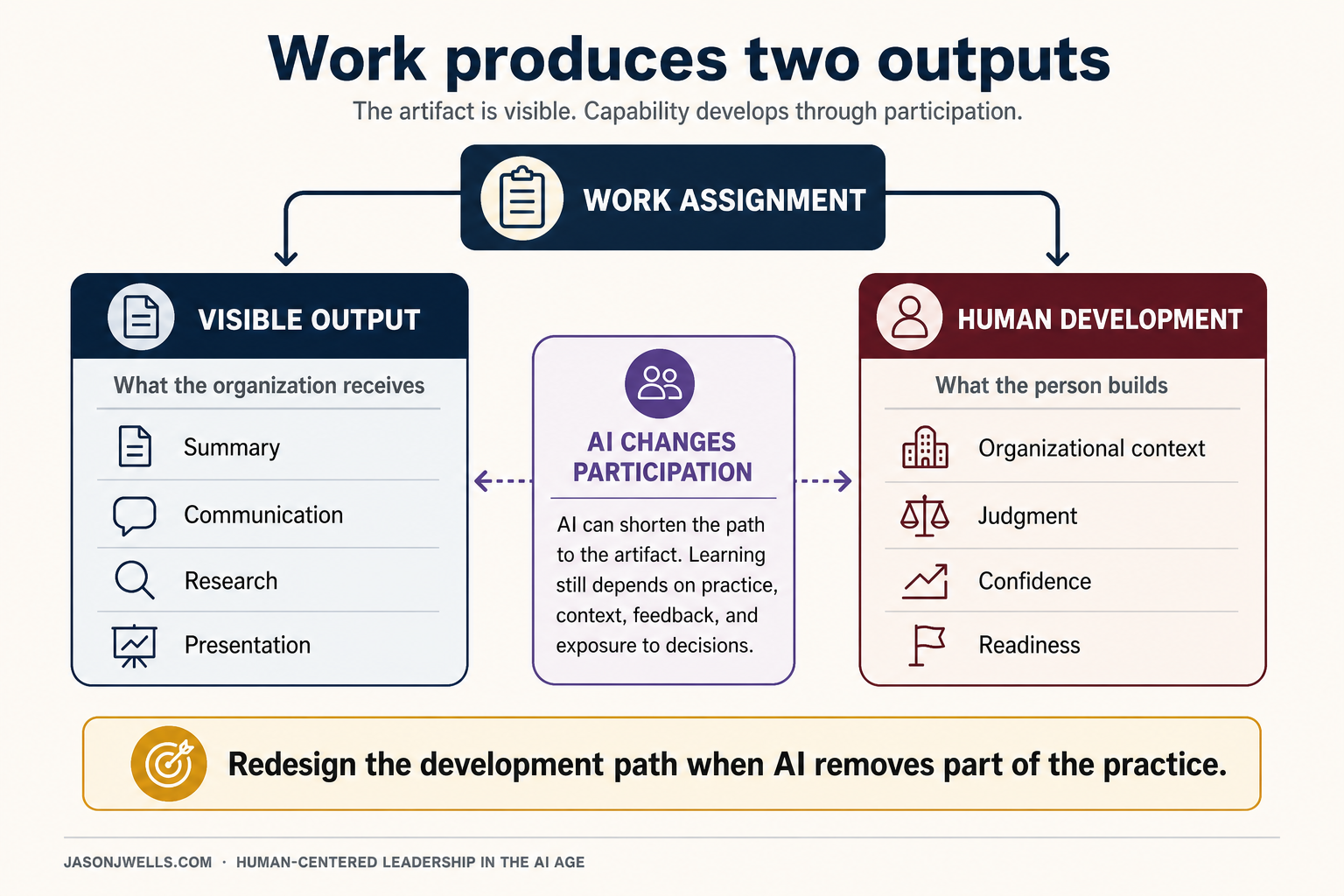
Meeting notes are one example of a much broader pattern. People learn an organization's voice by drafting communications, and they learn which questions deserve more attention by conducting research and discussing their conclusions with experienced colleagues. Preparing presentations helps them see how leaders weigh evidence and make tradeoffs.
Managers assign these tasks because the organization needs the work. Their supervision connects production with development as they review early attempts, explain what the employee missed, and gradually trust that person with harder assignments. Whether anyone intended it or not, day-to-day work has produced both something the organization needs and someone better prepared for what comes next.
AI changes participation
AI changes this pattern by changing how employees participate in the work. An employee may spend less time creating a first draft and more time reviewing, refining, or challenging something AI produced. That can remove unnecessary effort and create more time for work that requires human judgment.
Reviewing a finished AI draft requires context and judgment. A new employee may still be developing both. They may not recognize that a meeting summary missed the real decision or that a polished recommendation assumes resources the organization lacks. If a manager sees only the final artifact, they may also have fewer opportunities to notice gaps in the employee's reasoning.
We often describe the move from producing work to reviewing AI output as a move toward higher-value work. That may be true for someone who already has the experience needed to review it well. It is less clear how a newer employee gains that experience after AI removes some of the assignments through which people once developed it.
The immediate output can remain strong even as the path to greater responsibility becomes less reliable. If fewer employees practice interpreting conversations, weighing evidence, and learning from feedback, the organization may eventually have fewer people prepared to evaluate the work AI produces.
Design the learning as the work changes
I do not think organizations should preserve manual tasks simply because people once learned from them. They should use tools that reduce unnecessary effort and improve the quality or speed of their work. They also need to recognize when a new workflow removes the practice, context, or feedback that helped people grow.
Meeting notes offer a simple example. A manager could ask a developing employee to compare the AI summary with the conversation, identify what it missed, and explain which decision should shape the next step. The task changes, but the employee still practices interpretation and the manager can still see how that person reasons.
The manager may need to provide more context before asking for that critique. A new employee cannot identify a weak summary without understanding the organization, the people in the room, and the stakes behind the discussion. Examples, observation, and feedback give the employee a basis for making that judgment.
For years, much of this learning happened through the work, independent of whether anyone designed it to happen. As AI changes how employees participate, leaders can no longer assume that the same development will continue on its own. They need to decide where people will practice judgment and who will help them understand what good work requires.
Each organization will make different choices, and not every task carries the same developmental value. Before changing a workflow, leaders should ask:
- What did this task teach?
- Where will people practice that judgment now?
- Who will provide the context and feedback?
- How will we know they are ready for greater responsibility?
AI can shorten the path to a finished artifact, but the organization still needs people who understand what the artifact means and what should happen next. Developing those people now requires more intention than it once did.
Foundational series
Previous idea: The Most Likely Answer Is Not Always the Right One